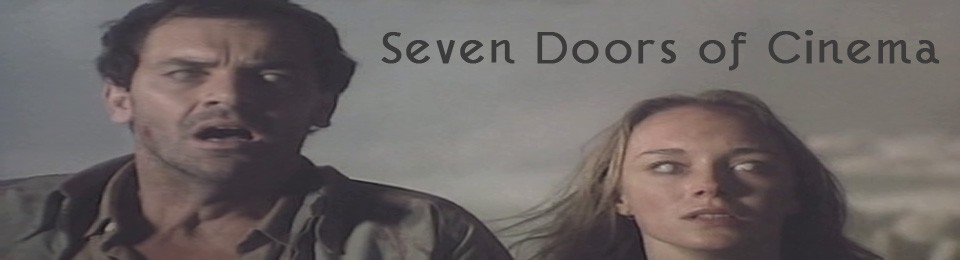
An analysis of why a movie theater in Demons (1985) and a TV studio in Demons 2 (1986) were chosen to bring about the end of the world. Scroll down to read the transcript or click below to listen on YouTube!
Next, in my series about evil technology Demons and Demons 2, a pair of Italian horror movies from 1985 and 1986, directed by Lamberto Bava and produced by Dario Argento. They basically made the same movie twice, but it works.
These two guys—there’s, it’s negligible who had more influence on these films—but it was a collaboration that ended up with something unlike what either of them did separately. I think these were Lamberto Bava’s best movies, and they may have been the most coherent of Dario Argento’s, so they worked well together.
Demons is a movie about an evil movie theater and projector, and Demons 2 is an evil documentary coming out of an evil TV studio within an apartment building where everyone’s watching the documentary on the TV.
So Demons one: there’s a guy on the subway with a metal mask. He’s a demon. He’s handing out free tickets to a movie showing, and this girl named Cheryl, she plays hooky from music class with her friend, who is afraid of horror movies and is dreading and doesn’t want to go to this movie, but she gets dragged along by Cheryl, who is inexplicably drawn to her doom and the end of the world.
There’s two guys, and one of them is named George, who pairs off with Cheryl, and these two become the final girl and final boy of futility, as you’ll see. The two guys are like, “To the girls, we’ll protect you,” and they do attempt to, but more importantly, there’s a guy named Tony who’s very charismatic, played by an actor named Bobby Rhodes.
He’s in both of these films. There’s many links between the two films. Bobby Rhodes has got two girls with him. It seems to be a pimp-hooker situation, but maybe they’re just party people. I don’t know. Everyone calls him Tony, the pimp.
One of the girls finds the same metal mask from the train in the lobby of the movie theater and cuts her face, but the transformation doesn’t take place right away. The movie starts, and the guy from the train is in the movie, and it appears to be showing that sometime in the past they’ve caused a demon uprising with the mask.
Then one of the girls with Tony transforms into a demon, and the other one quickly, and then it’s spreading through the theater. Tony and George try to mobilize everyone to protect themselves or find a way to escape, but they can’t escape. And they can’t stop the movie, and no one’s running the projector.
But enter another group of people who are in both movies, or at least one of them. There’s a carload of cokeheads that are running from the cops, and they open a back door of the theater. That lets the demons out, and the world comes to an end.
But not really, because now it’s Demons 2, and everyone’s in this high-rise apartment building. They are watching a documentary on TV, various people throughout the building, about this former demon uprising and how it ended in a way that nobody really knows how.
So the main characters in this: Tony, the pimp, is back as Hank, the gym instructor who tries to fight off the demons because there’s a gym inside this apartment building. It seems to be one of those self-contained apartment buildings that used to be in the movies during the 80s, like in Poltergeist III.
There’s a teenage girl named Sally who’s having a birthday party that seems really fun, but she’s not having any fun because the guy from the carload of cokeheads from the first movie calls on the phone, and this dipshit at the party answers the phone and says, “Sure, come on to the party.”
Sally freaks out because this guy is on the way to the party and is going to be allowed upstairs and is heavily implied that he’s sexually assaulted her or done something terrible to her, not just like a romantic breakup, but really something awful.
And all of that energy coming from her, you know, she feels like it’s the end of the world because this guy is coming to HER party. She locks herself in her room, where the documentary about the previous demon uprising is playing on the TV, and she’s so upset, there’s so much energy coming out of her that a demon comes out of the TV.
Then she infects everyone at the party, and they all go running through the building to the sound of The Smiths’ “Panic.”
And one of her neighbors, though, is a pregnant woman, and then you have to spend the rest of the movie suspensefully wondering if the baby’s going to come out a demon. And they foreshadow this by having a dog transform into a demon, and a demon burst out of someone’s body instead of the whole person transforming.
The pregnant woman and her husband get separated in the building, and they’ve got to find their way back to each other and have the baby and get out and find the evil movie studio and possibly stop Sally.
And I’ll end there, because if you haven’t seen these, you need to watch them.
But, you know, the thread between the two movies is that Argento, I think, was criticized for violence in his films. There was a movement in the 80s, with media saying that horror films would cause people to be violent. Heavy metal music was supposed to cause people to be violent, and that’s the soundtrack of the first movie.
The second movie, the soundtrack is all alternative music, but I think that Argento and Bava made these movies as a pushback on the idea that movies make people violent for two reasons.
First, they’re thumbing their nose, like it’s a ridiculous notion that movies make people violent. So we’re gonna literally show a movie, a projector, a studio, and a TV bringing on this demon apocalypse that ends the world.
But a more fatalistic viewpoint, if you look at the two movies together, and also they made a lot of sequels that said Demons on the package but weren’t really sequels. But there was one that was important called The Church. And it was directed by the guy from the train in the beginning, who is drawing people into the theater in the first movie, Michele Soavi.
So the pessimistic interpretation of what all of these three movies are trying to say is that violence is a part of the human condition.
Because yes, the projector in Demons one starts the demon apocalypse, but the movie is depicting how this has already happened, and then it just ends, and everyone seems to forget about it.
And then in Demons 2, they’re showing a documentary about that uprising, and then it happens again.
And then The Church, which is one of the Demons sequels, shows that there was a demon uprising in the Middle Ages and starts with some people burying all the demons in a pit and building a church over it.
But then archaeologists let the demons out, and it happens all over again in very much the same story beats as Demonsone and Demons 2.
So these movies are, on one hand, laughing at the idea that media causes violence, but also making an overarching point that there’s nothing you can do about violence, that wars are always going to happen, that people are always going to prey on one another.
And then the good news is that this too shall pass, that things always temporarily get better, and everyone is living their best life and forgetting that demons are just around the corner.
So let me know in the comments if you’ve seen these movies and love these movies the way that I do, and don’t forget to not skip your music lessons and don’t touch things that don’t belong to you.
And keep fighting, because there’s something terrible around the corner, but there’s also something wonderful around the corner. And have a good day.


“Movies don’t create psychos. Movies make psychos more creative!”
LikeLike
Once again I’ve seen neither of these but I love the idea that they both (or three) were like “ok great thank you you think our movies are violent but you see how this cycle works see violence begats violence and all of that stuff see it’s not just our movies it’s the social platforms you are using to denounce violence, these incite violence see”. Good for them!
LikeLike
Yes, and Argento was already pushing back on the criticism of his violent as hell movies with Tenebrae which is just a straight giallo with no hocus pocus. If you’re interested, definitely check out Demons!
LikeLiked by 1 person