Tags
1940s Movies, classic horror, film analysis, Hays Code, Psychological Horror, Queer Coding, The Seventh Victim, Val Lewton
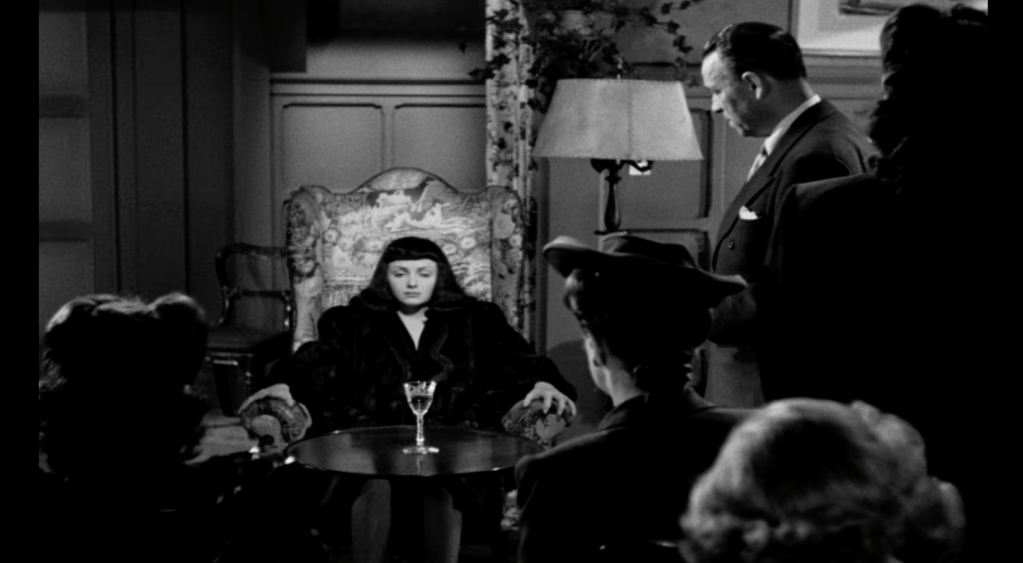
Official synopsis as stated by HBO and TCM: A girl’s search for her missing sister puts her in conflict with a band of Satanists.
The Seventh Victim is listed under horror, and also is uploaded to the TCM hub of HBO, so I was drawn to it. Having now been compelled to watch it twice in search of clarity I find myself even more drawn to it, although it leaves me with some feelings of frustration. I got the sense very early in the film that this was one of those movies that was written in a sort of code to get around the censors, even though I didn’t know exactly what was being encoded. I think a movie can in fact have a sell-by date, an idea I’ve never really endorsed before, but it all depends on how clearly the point of the movie was made to begin with. Simply put, I’m at a disadvantage here 80 plus years in the future because I don’t know how things would have been implied to a 1943 audience, and I have not been raised with the same taboos that would even make implication versus explication necessary in the first place. But I am willing to put in the work to understand something that is encoded, especially a work of fiction that affects me emotionally. However, with The Seventh Victim I’m impeded by the triple whammy of outdatedness, deliberate obscuration of themes, and plain old bad editing.
Unofficial synopsis: Mary is a young orphaned woman, age not stated, attending a boarding school Jacqueline pays for. Her headmistress calls her into the office to tell her that Jacqueline has long since stopped paying and also has disappeared, and the only other contact, Jacqueline’s co-worker, is being unhelpful. Mary is given two choices: stay and attend on a work/study scheme, or be advanced the money to go to the city and look for her sister.
Mary does go to the city and said co-worker, Mrs. Redi, is indeed unhelpful. Mrs. Redi has bought Jacqueline’s business, which might be a perfume factory and might be a salon. Another employee, Frances, who is previously known to Mary, says she’s seen Jacqueline at an Italian restaurant. The restaurant owners after some back and forth show Mary to a room Jacqueline has rented from them upstairs, but there’s nothing in it but a noose and a chair.
The police aren’t much help, but there’s a private detective at the missing persons’ bureau who wants to help in exchange for 50 dollars. She doesn’t have it, but she says she’s going to get a job. He mentions looking in the hospitals and morgues, so Mary goes to the morgue without hiring him and finds out that a man named Mr. Ward is also looking for her sister. Ward is an attorney, and secretly Jacqueline’s husband, but there seems to be no love between them when we eventually find her. After we find her, three times in fact because she keeps disappearing again, the movie spirals even more into less of a story and more of a feeling: frustration, and a ghoulish desire to see what will happen next.
Going back to my certainty from the beginning that this story is not what it appears to be at all, critics agree that this is a film about homosexuality, specifically between Jacqueline and Frances. This leads me to wonder if the marriage between Ward and Jacqueline was a lavender marriage, or what we now call a mixed-orientation marriage, in order for both to appear straight. But then why would Ward not tell Mary he was her brother-in-law? I also realized once learning about the film being gay-coded that there is a scene right at the beginning in which the assistant to the headmistress tells Mary to leave the school and never come back, because Mary has been told that she can always return. The assistant (Ms. Gilchrist) explains that she herself was an orphan who tried to make her way in the world after leaving that same school, but was not brave enough and came back, and now she can’t leave. Is Ms. Gilchrist stuck at the school because she’s institutionalized, in other words, not psychologically strong enough to exist outside the structure of the school that raised her, OR, is she in a power-imbalanced sexual relationship with the headmistress, Ms. Lowood?
Later in the film Mrs. Redi breaks into Mary’s apartment while Mary is in the shower and tells Mary to leave, stop looking for Jacqueline, and go back to the school, which I believe is a deliberate callback to Ms Gilchrist’s warning. This was a scandalous thing to do in 1943, going into someone’s apartment and verbally abusing them while they are in the shower, naked and vulnerable, but was it gay-coded for the time? Predatory lesbians seem to thrive in the fiction of the 40s and 50s enough for these scenes to possibly be coded. Another theme that comes up when depicting lesbians in older media is suicide. Jacqueline eventually makes use of the noose and chair in her rented room, but it’s not explicitly due to her relationship with Frances; instead, it’s because she’s in a cabal of satanists which includes Frances and Mrs. Redi, and the cult tells her she has to kill herself because it’s in the rules of the cult for anyone who betrays them. Jacqueline is the seventh victim of the title. Six other people have betrayed the cult. They are a non-violent cult by rule, unless someone betrays them, which Jacqueline has by seeing a psychiatrist.
Jacqueline allows a shadowy cabal of religious fanatics to dictate she should abandon the child she’s responsible for. She displays no more concern for Mary than the clippings swept up from the floor of the hair salon/perfume factory she owned. Her fate is telegraphed right from the opening of the film: before we even see any characters we see a card with part of a John Donne sonnet “I run to death and death meets me as fast, and all my pleasures are like yesterday.” We hear this line spoken by a woman’s voice as the last bit of dialogue too. So are the satanists symbolic of depression, or the fear of one’s homosexuality?
I liked Mary as protagonist when she was off and out into the world to solve a mystery, though I guess this got subverted. At the very beginning she’s going up the stairs at the office while all her classmates are going down the stairs. We hear a girl’s voice conjugating the Latin verb To Love, and we hear another voice conjugate the French verb To Search after Mary leaves the office determined to find Jacqueline. Then we hear a voice recite part of the poem The Chambered Nautilus by Oliver Wendell Holmes Sr.: “Build thee more stately mansions in my soul as the swift seasons roll.” This poem evidently compares the spiral of a nautilus to personal growth, which Mary is approaching. But the story soon becomes less about Mary and more about Jacqueline, who is not written or acted in such a way as to inspire, and Mary’s story becomes more about whether she will choose an ill-advised relationship with her brother-in-law, or with a poet who also takes on the role of a private detective. Is Jacqueline also a symbol of something Mary hopes to attain, with a girlish and naive view of what life is like? We know that Mary admired her sister but also found her careless. Careless doesn’t even begin to describe giving away a successful hair factory, cutting your hair in tiny bangs, abandoning your family, and joining a satanic cult.
No, this movie can’t be about anything but the seemingly irrational way a person behaves while in the depths of a major depression, behavior which seems so frustrating to the ones who love them, and yet is perfectly reasonable to the sufferer themselves.
Mary does find work as a kindergarten teacher and is at one point seen teaching her students the English nursery rhyme Oranges and Lemons which includes the line, “here comes a candle to light you to bed, here comes a chopper to chop off your head,” which just seems to go well with the dank nature of the film.
It’s very convenient to completely obscure yourself in shadows in a black and white movie. Also, there is a moment when the psychiatrist says to the poet after Jacqueline is found for the third time in the film, in regards to their own association, “to me this seems to be the end of a delightful relationship.” Is this a deliberate play on the “beginning of a beautiful friendship” line at the end of Casablanca, which came out the year before? If so it might be the only humor in the film, aside from the Italian restaurant owner’s repeated assertion that the dour poet is in fact a very funny man. The Seventh Victim is a deliberately and accidentally confusing movie, and yet somehow one that I won’t be able to forget.

