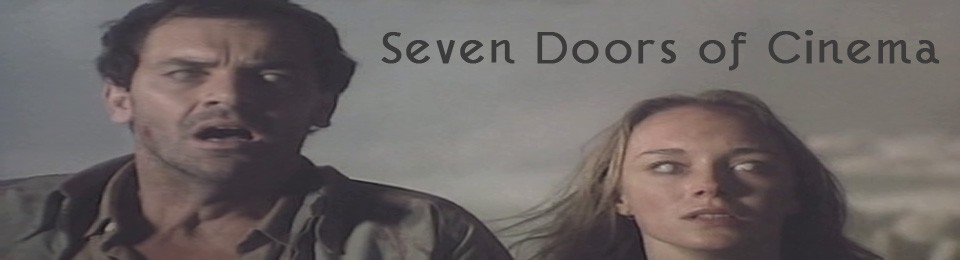
Sleeper, awaken to the odd, 1986 neo-noir world of Sara Driver’s Sleepwalk in this audio-only episode of Erin Strolls Through Films. Join me as I explore the surreal New York City temp office and the bizarre folklore manuscript. An early career appearance by Steve Buscemi inspired me to go on a tangent about the archaic tech of slide projectors. Listen below or scroll down for the written essay.
Watching Sleepwalk today was a choice to turn off my brain and enjoy a collection of surreal images. But what I got was a linear plot that kept me paying close attention, with surreal elements.
Nicky works in a New York City temp office where no one seems to accomplish anything. One of her coworkers tears up paper all day, and a young Steve Buscemi arranges and rearranges a pile of slides, while the office manager eats Tato Skins chips. Remember those? They’ve got baked potato appeal, ’cause they’re made with potatoes and skins that are real.
Nicky apparently speaks and reads Chinese, and therefore she’s approached by a Chinese man named Dr. Dog to translate a manuscript of folktales. He’s accompanied by a pre-Candyman Tony Todd, though I didn’t say “Tony Todd” three times into my TV screen. Tony’s character has two mangled hands and is meant to be the enforcer here, though he seems more vulnerable than menacing.
Nicky’s finger spontaneously begins to bleed and that blood gets on the manuscript, which is as we all know a contract to do temp work for a couple of mysterious guys. As she untangles the folk stories, they begin to cause real world consequences like total alopecia and even murder. There’s a slow descent into big weirdness for Nicky, but she’s not even the type to notice things like children who demand to be escorted across the street only to walk back across, or even the basic needs of her own child.
Now, I said Sleepwalk has a plot, but nobody has a clear motivation.Actually there’s only one person who has motivation, and that’s Nicky’s roommate Isabelle, played by Ann Magnusson doing an OUTRAGEOUS French accent. And her motivation is to get her lost hair back, which drives the plot to an accidental kidnapping, which results in the only real suspense to be had here, even though we’re in an obvious neo-noir picture.
We know it’s noir because there are images of venetian blinds, and because the third act begins with a wonderful elevator ride scene for Nicky, which reminded me very much of the elevator ride in the beginning of The Big Clock, with the doors opening on each floor to give us a tableau of mild weirdness each time.
I have to back up to Steve Buscemi’s job here because I’m so into old tech. I had almost forgotten about slides, and they were ever-present for my entire childhood. For younger listeners, slides were photos but smaller, encased in paper, and you inserted them into a round projector in the order that they would be shown, to magnify them onto a screen. This was before PowerPoint took over the same function.
They were used in school, often with an accompanying soundtrack on a record or tape. And in movies, people who took long boring vacations always owned slide projectors and would invite reluctant friends over to watch a presentation about their trip. It was a running joke that wouldn’t make sense in a movie today. And nobody traps guests into a PowerPoint presentation about their vacation with the promise of dinner and cocktails before, unless they also happen to be recruiting for an MLM, I suppose.
Anyway, Sleepwalk builds to a cliffhanger ending that will probably be resolved with probability or common sense when the protagonist wakes up in a different movie. If you can enjoy a long elevator ride that stops on a lot of floors but never quite gets you where you’re going, this is the film for you. It certainly was the film for me, today. I might watch it again right now.
Directed by Sara Driver and lensed by Jim Jarmusch, Sleepwalk came out in 1986 but was unavailable on home video for a time and so is somewhat unfairly obscure.
Discover more from sevendoorsofcinema
Subscribe to get the latest posts sent to your email.
