Tags
1997, colors as symbolism, Cure, Kiyoshi Kurosawa, Koji Yakusho, Masato Hagiwara, recurring images, Tsuyoshi Ujiki
I put a spell on you cause you’re mine.
I must tell you about Kiyoshi Kurosawa’s mystery/horror film Cure today now, because thinking about how to explain this movie to myself is starting to invade my dreams. More on that later.
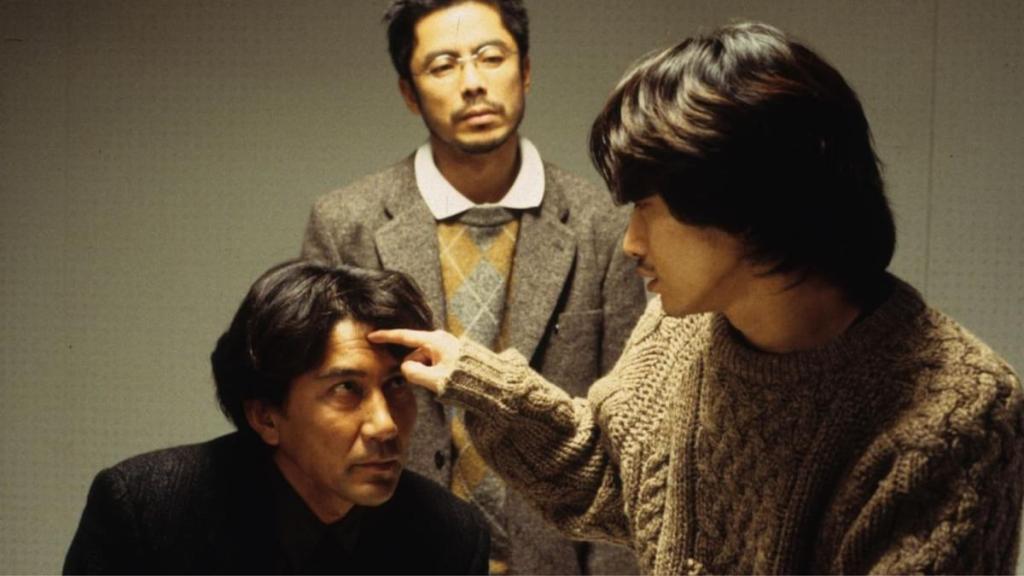
I hate to write synopsises? (synopses?) and Cure is notoriously difficult to summarize, but if I just go ahead and do it then it will help me explain what I really want to talk about, and that is the use of color in the film, as well as the imagery here that repeats in other K. Kurosawa films. Detective Takabe is fighting on two fronts. He’s on the trail of a serial killer who marks all of his victims with vicious “X” shaped wounds. But each time the obvious, bang-to-rights killer is apprehended, another murder happens with the same X while the last person couldn’t possibly have done it seeing as how they’re in jail. Takabe is also caring for a wife at home who has some sort of amnesia or dementia. Somehow it is determined, both by what is shown to us and through research done by Takabe and the police psychologist Sakuma, that the killer is not physically the killer at all, but a hypnotist named Mamiya who, using both magic and psych out, induces other people to actually do the killings.
As is customary in films which originate in a tradition where spirituality is openly discussed, everyone in the investigation is immediately on board with this idea of occult hypnosis and we don’t have to spend half the film listening to some materialist characters scream about how this can’t be happening; they just get on with finding Mamiya and bringing him in to question. The problem with that is that it’s very dangerous to question a super hypnotist because he’ll just hypnotize you too. Finding Takabe hard to crack, Mamiya obtains the information he needs to manipulate Takabe by putting the whammy on a junior officer, and this leads to whatever the hell has happened by the end of the film.
Better and more motivated writers have attempted to unpack what has happened in the end, so I urge you to watch Cure for yourself and decide. I’m not sure a decision can be made, and from remarks by the director as well as being somewhat familiar with his catalog (the more terrifying and stupefying Kairo, anyone want to take a crack at that one) I’m not even sure there is an answer. But what I can tell you is that the palette of this film is dominated by the shade of brown which used to be known as khaki, a sort of blue/aqua color that you used to see in institutional buildings in the 20th century, and occasional “now pay attention” uses of red, beyond the obvious sight of the blood that gets spilled.
Khaki was such a dominant color in the world in 1997 that it had long been not only an adjective but a noun. Khakis referred to military uniforms, as well as pants in that shade that were worn by young people when they wanted to look casual but still elite. It is also a color associated with hunting, of the safari or exotic variety, before hunters wore orange or camo. Both Takabe and Mamiya are dressed in khaki for almost the entire film, and most of the interiors and exteriors are the same color. (Audiences of today might call this color “beige,” and it is now employed as a pejorative against women who aren’t sexual enough or loud enough or who are older than you.) But to the 1997 viewer this was definitely khaki, and had strong associations with detectives, hunters, and the military. I’m not qualified to get into any overall metaphor about 20th century Japanese society and the military, but I suspect it could be here.
I am saying that Takabe is hunting Mamiya, and Mamiya is hunting him right back. And one or both of them is/are hunting their victims, both primary and secondary. The killers who get hypnotized are victims as well as the people they are induced to kill, and this is made clear in the first interview between Takabe and Mamiya when the former deals out all the photos of the incarcerated killers in a row, and then the crime scene photos of the dead. It’s exotic hunting, because they’re hunting people. The old “most dangerous game” plot. Why? I don’t know. Some people have this view that everyone is capable of murder, but then again as the film says, it would take an expert hypnotist to make someone do it.
But what I do know is that the khaki is broken up with this institutional blue color on the walls of the hospital where one of the hypnotized killers works as a doctor, and also on the carpet in the courtroom scene in which Takabe is trying to convince a panel of Very Important Officials that Mamiya must be held and charged for these crimes along with the actual knife-wielders. And finally, in a very odd decorating choice, the long curtains that dominate Takabe’s home interior are made of this awful institutional blue, linking to his wife’s illness. I think that blue was used in schools here in the US and probably jails, as it was thought to be calming. What is clear from all this blue and the actual plot of the film (such as I can determine) is that all but one of Mamiya’s hypnosis targets are members of the establishment or institutions: an elementary school teacher, a doctor, a uniformed policeman, a junior detective, possibly a nurse, and Takabe. He even tries it on with one of Takabe’s intimidating superiors during the courtroom scene. As disturbing as it is to watch people being killed, I also had a sense of how awful it is to watch these respectable people forced into throwing their lives away in real time by committing the murders, especially the doctor. You could even say it left me feeling blue.
Best and most mysterious of all, the color blue, perhaps a different shade, is mentioned at the very beginning of the film when we witness Takabe’s wife Fumie talking with her doctor about the story of Bluebeard, the pirate who kills all his wives except for the last one. I have to watch again but I think she is holding a book and it is blue. Fumie misremembers the story’s ending as being that the last wife, the one who discovers Bluebeard’s victims, eventually kills Bluebeard. Later, Fumie doesn’t remember having read Bluebeard or discussing it, and I’m not sure what this means other than that perhaps she also is a hypnosis victim and not actually ill. But I can’t overlook such a blatant use of blue. It’s right in the opening of the movie, which lets us know it’s important.
Finally, there is red. I noticed red in three scenes. Takabe and Fumie are being transported in some sort of vehicle (it looks to be a skyway or tram because all you see are clouds) with red upholstery when he takes her to be admitted to a mental institution (supposedly to keep her safe, but in the end we’re not sure if it works). I mean, we’re not even sure if they go there, a theory which is helped along by the clouds in the windows of the vehicle. The last act of the movie makes it obvious that we don’t know what is happening here at any time, or what is a hallucination brought on by hypnosis. We don’t even know who is doing the hypnotizing by this time. But the red seems to indicate this confusion and perhaps a dreamlike state. We see the same vehicle transport Takabe alone at the end, only this time his destination is a vacant and deteriorated asylum. Did he ever go to the first one, and did he take Fumie there? Did it exist at all? Did the vacant one?
This confusion is corroborated by the other big use of red, when we are shown a red dress at the dry cleaners. Takabe goes to pick up his clothes, which we did see him leaving at the dry cleaners earlier, and is told they have been already picked up. By him or by his wife, we don’t know. Who has the ticket? Oh, and I’m just remembering now that early in the film, when we didn’t know Mamiya’s name, one of his victims finds it written on a red tag inside Mamiya’s khaki trenchcoat. But as that guy, the aforementioned schoolteacher who is about to kill his wife, has already been mentally tampered with, the red is a clue to that confusion as well.
That red dress at the cleaners? We see a woman in a red dress as the main image in Kurosawa’s film Retribution, and in that scene in Kairo where the ghost dances across the room at the guy hiding under the couch. Mamiya is the name of both the first killer here and the ghost woman who pops out of a huge mural in Sweet Home. And that brings me to the fact that this director loves to have people appear out of and disappear into walls, as shadows, and ghosts, and big person-shaped stains, and detectives hiding in plain sight in the corner of your waking nightmare.
As I said, I’m somewhat a fan of the director, although his movies confuse me. There’s not another supernatural horror film that gets to me viscerally the way that Kairo does. I actually get goosebumps all over every time I rewatch it. Every time I look for a Japanese horror movie to watch, I’m looking for Kairo again, but there’s nothing like it. And that’s even with it being inscrutable. But there was a moment in Cure that came close, and I really don’t know why. Throughout the movie, Mamiya has mostly been using a cigarette lighter to hypnotize, though he did use water on the doctor. But Takabe doesn’t know about the water, and he’s foolishly gone into a dark cell alone with Mamiya and taken away his lighter while he attempts to question him. Then Takabe flicks the lighter, an old butane Zippo style one, sets it down, and lets it burn. Suddenly the camera almost freezes to the point where I thought my internet had buffered, and focuses on a spot above Takabe’s head in the dark. You see these silvery sparkles appear out of nowhere, and I thought I was actually seeing the demon that must be at work here, at the moment it goes from Mamiya to Takabe. But it was actual water that manifested from nowhere, and it extinguishes the lighter.
My husband thought it was hilarious that I got really frustrated with Mamiya throughout the film. The actor plays the part with a nonchalant malevolence. He’s sleepy, he’s leaning on the wall, he’s pretending not to remember what you just said. It’s like I was hypnotized to wish harm on Mamiya. I said that I couldn’t wait for Takabe to finally beat him up, as detectives with personal problems are wont to do. But what does happen to him is pretty shocking, different from what happened to anyone else who met their fate. and yet seems possibly orchestrated by Mamiya himself so that he can be released. We’re never even sure if he’s aware of what he’s doing, to be honest, and he might himself be under hypnosis, or possessed.
Hell, we the audience might be hypnotized. I’ve tried to watch this entire film several times since about 2009, but the problem with Japanese movies is that you have to stare unblinkingly at the screen because of the subtitles, so I always put them on when I’ve settled down for the night, and often turn them off and go to sleep halfway through. I remembered some of what was going to happen while watching last night, but I’m not sure I had ever seen the ending before, and I’m pretty sure I had the plot mixed in with Retribution anyway. I was determined to finish it, even though I had to pause several times to read theories.
But what about my nightmare? It was more of a daymare really. I was lying in bed awake this morning trying to write this in my head, and suddenly I was in an airport. There were two women dancing in front of the check-in counter, but standing far enough back that I could go up to the counter, and for some reason against my better judgement I joined their dance. The ticket agent said, “that’s it, all three of you are barred from this flight.” And I was complaining that my luggage was already on the plane when I realized I had fallen half asleep and this was a dream. Luggage, baggage, a lot to unpack here with Cure. Fumie’s luggage on the transport with the red seats while Takabe is not taking her on vacation to Okinawa as she had dreamed of, but sending her away, forever.
 sevendoorsofcinema